Showing posts with label Books. Show all posts

Wednesday, 19 November 2014

The Good, The Awesome and the Stress of NaNoWriMo

THE GOOD, THE AWESOME AND THE STRESS OF NANOWRIMO
By Marie Victoria Robertson
Hey look, we’re in the second half of November! Show of hands, who’s participating in NaNoWriMo this year? Are you cool as a cucumber because you’re in the home stretch of novel-writing, or are you frantically calculating how many words a day you need to write to finish on time?

Incidentally, it’s pronounced “Nah-no wry-moh”, and for the uninitiated, stands for National Novel Writing Month. It’s that once-a-year kick in the arse a lot of aspiring writers (and some seasoned pros) need to finally get started on that novel that’s been percolating in their brains for all this time.
So what’s the deal with NaNoWriMo? Founded in July 1999, the idea was to unite people through a common goal—writing 50,000 words (about the size of a small novel) in a month. NaNoWriMo has well over 200,000 participants now. You sign up through the official NaNoWriMo website, write your novel piece by piece in your own word processor, and update your word count on the site as you progress. You “win” by reaching the 50,000-word count before the end of the month. It’s open to anyone around the world writing in any language of their choosing. 
For a lot of aspiring writers, getting that first novel finished can be daunting. NaNoWriMo is the perfect motivation, keeping you encouraged and accountable for your writing. 
I’m personally not participating this year, though I have in the past. By the time of this article’s release, it will be too late to sign up for NaNoWriMo 2014, but here is some advice you can store away for next year, or hold on to for whatever writing project you’ve got on the go. 
1. OUTLINE
You may not be allowed to type out a word of the novel itself before November 1st, but that doesn’t mean you can’t outline. Seriously, outline. The first piece of writing advice I always give my students is to lay out the plan for your novel. You’ve seen artists draw out a quick pencil sketch before they get to work, right? The same applies to writing. Write down your story arcs from start to finish, flesh out your characters, make sure you know exactly how your story’s going to end, even if it’s going to change later. You’ll feel much more inspired to write if you know exactly where you’re going.  
2. FIND SUPPORT
The most wonderful part of NaNoWriMo is the community aspect. Participants help each other stay motivated thanks to local write-ins, support through forums, and pep talks
3. IGNORE YOUR INNER EDITOR… FOR NOW
What you’re writing down now is not your final draft. It’s supposed to “suck”, to not make sense, to look like terrible writing. You’re going to edit this later, but you can’t edit anything unless you have a first draft, and since you’re on a time limit, you need to focus on getting to the finish line first. You’re much better off with 50,000 words to edit than 500 words of “perfect” writing. 
4. EVEN IF YOU “LOSE” NANOWRIMO, YOU STILL WIN 
Maybe you’re 1000 words away from the end on November 30th. Maybe you’re 25,000 words away. You know what? It doesn’t matter. Maybe you didn’t technically win, but you’ve got your novel started. Keep going into December. Keep going into January. Keep writing, and think about what you can do next year to make it to the end. 
You wrote, and that’s a hell of a lot more than other people can say. 


Marie Victoria Robertson is a published speculative fiction writer and playwright, as well as the board president of Jer’s Vision: Canada’s Youth Diversity Initiative (www.jersvision.org). When all the other girls wanted to marry Johnny Depp, she wanted to run away with Worf on the Enterprise. She enjoys giant robots, time-travel paradoxes, and dressing up her kids like Ninja Turtles.

Monday, 18 August 2014

Pemberley Digital and Interactive Storytelling

PEMBERLEY DIGITAL AND INTERACTIVE STORYTELLING
By Courtney Lockhart

For the past couple of weekends I have indulged in one of the universal vices of the digital age: Binge Watching.  I made my way through approximately 300 episodes of three different series in less than 96 hours and before you ask: yes I did eat, sleep, shower and occasionally leave the house.  It helped that the episodes were less than 15 minutes each.

So what had me so enthralled? Four words: Jane Austen on Youtube.  

It started with The Lizzie Bennet Diaries, a modernized version of Pride and Prejudice told through vlogging and social media.  The transmedia approach means that in addition to Lizzie's point of view, the audience can follow other characters, like trouble wild child Lydia or supportive best friend Charlotte through the story.  There are no one dimensional  characters. Even if there isn't enough time in the videos to flush everyone out, they can keep developing through Twitter and Tumblr.  For example, during the first week of the story when Lizzie and her sisters are being introduced to us on the main channel, over on Twitter you can read along as Bing Lee surprises his sister Caroline and best friend William Darcy with the news that he bought a house called Netherfield.

However, all the cross platform promotion would mean nothing if there wasn't a quality program to go with it. The writing is wonderful and the performances are enthralling.  The Lizzie Bennet Diaries
won a 2013 Creative Arts Emmy for Best Original Interactive Program and I have rarely seen a show deserve an award more.

Thanks to DVD sales and an overwhelmingly successful Kickstarter campaign Pemberley Digital, the production team  behind LBD, has created two more equally addictive series. In Welcome to Sanditon  the viewers become a part of the story. Based  on Austen's unfinished manuscript Sanditon, Georgina "Gigi" Darcy moves to a small California beach town to beta test her brother's latest technological marvel. Written story arcs are combined with fan made videos to show a town in the middle of a social civil war. They followed up with their take on Emma called Emma Approved. Emma Woodhouse is a lifestyle guru documenting everything that goes on in her office for the eventual lifetime achievement award she expects to receive- much to the chagrin of her business partner Alex Knightley.

This week Pemberley Digital will premiere it's first non-Austen series. Frankenstein MD starts on PBS Idea Channel August 19th.  Set in a modern university, Victoria Frankenstein  is determined to prove herself through her unorthodox experiments. This will be the first time I will be following a Pemberley production live and I'm pretty excited to play along.

Courtney Lockhart lives in the west end of Ottawa with her husband and step-cat.  She is polishing her skills to pursue one of her dream careers as either a costume drama character, Torchwood operative or executive assistant to a billionaire vigilante. You can follow her daily mission to DFTBA on Twitter @corastacy.

Wednesday, 21 May 2014

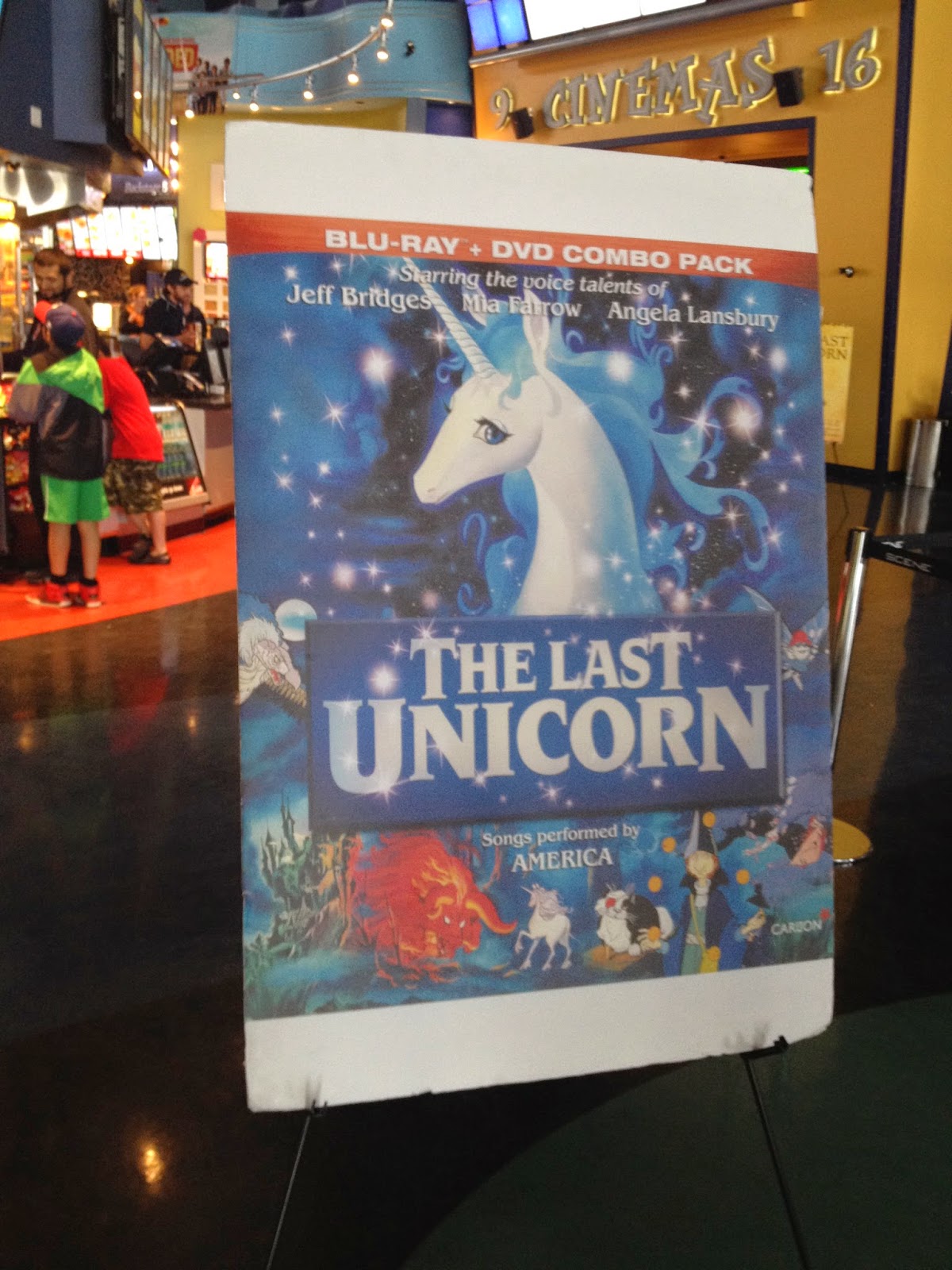
The Last Unicorn and Peter S. Beagle Visit Ottawa

THE LAST UNICORN: CANADIAN SCREENING TOUR AND CHAT WITH THE AUTHOR
By Marie Victoria Robertson


I was going to start by saying ‘This weekend, I had the pleasure of seeing The Last Unicorn and meeting Peter S. Beagle’. But to call it a ‘pleasure’ would be a huge understatement.

The 1982 movie The Last Unicorn, along with Peter S. Beagle, the author of the 1968 novel, has recently toured through Canada and, as of this writing, is about to conclude in the maritimes. Like most children of the 80s, I grew up enamored with the movie—it was the source of wonder and escapism I needed in my sometimes-grim childhood. When I discovered the novel, I was in love. It was obviously written from a place of great love for magic and the little mysteries of this world.

In the story, the titular last unicorn embarks on a quest to locate the others of her kind, who have been driven into the sea by the Red Bull. She is aided on her quest by Schmendrick the fumbling magician, and Molly Grue, the sassy scullery maid. Along the way, the unicorn temporarily turns into a human woman, and learns about love and regret. 

The Last Unicorn was written from 1962 to 1968, though it took two years of cumulative writing. The half-finished book, Mr. Beagle said, was stashed away due to his doubts about the story, and it was only at the insistence of his wife that he pulled it out again and kept working at it. 

Seeing the movie on the big screen at Silvercity was a treat. It was heartening to see so many youngsters in the audience, a new generation of boys and girls who will grow up knowing the movie like I did. But it was the presence of Peter S. Beagle, there for a signing and a Q & A, that made my day. I was fortunate enough to speak to him before the movie, before the fans began to swamp him.

Mr. Beagle absolutely radiates charm and sweetness. He graciously took questions from tiny children at the Q & A and answered them on their level. When I confessed an attack of nerves at the thought of speaking to him, he told me, “Don’t be nervous! I’m nothing special, just an old man who fell asleep in the van on the way over here.” He then took my hands and we talked about books and writing for so long that I was worried the people around me would start a mutiny. 

But this is Mr. Beagle’s way. When an organizer was asked how long he would stay after the movie, the reply was “As long as it takes for him to meet and speak to every fan!” Class act, all the way. 

I asked him what his favourite books were as a child. He said he was fond of the Jungle Books, Edgar Allan Poe, and “anything with animals”. I was moved to hear him talk about how Molly Grue was his favourite character; she wasn’t based on anyone in particular, but was influenced by several strong women he’d known in his life, including his mother.

“How did you invent the unicorn?” a little girl asked him at the Q & A.

With a good-hearted smile, Mr. Beagle explained how the concept of the unicorn came from all the mythology tomes and tales he’d devoured as a child. As an interesting point, it was mentioned that, before The Last Unicorn was written, unicorn in myths and culture had always been depicted as male. Mr. Beagle was responsible for creating the concept of the female unicorn. 

He was responsible for so much more than just that, of course. The Last Unicorn is a childhood classic that will surely continue to spark children’s imaginations for years to come. 

Thank you for the memories, and thank you for my childhood, Peter S. Beagle. Despite what you may think, you ARE special. 


Marie Victoria Robertson is a published speculative fiction writer and playwright, as well as the board president of Jer’s Vision: Canada’s Youth Diversity Initiative (www.jersvision.org). When all the other girls wanted to marry Johnny Depp, she wanted to run away with Worf on the Enterprise. She enjoys giant robots, time-travel paradoxes, and forcing her son to watch Futurama

Tuesday, 29 April 2014

Dystopian Fiction: a user's guide

by Marie Victoria Robertson

DYSTOPIAN FICTION, THEN AND NOW


While browsing a bookstore recently, I overheard a conversation between two young people. “This is a great book!” one gushed. “It’s, like, a dystopian story, but everything works really well!”

Which had me thinking, like, that’s rather the opposite of dystopia. Maybe the label “dystopian fiction” is being applied a little too liberally these days, because it is the new “hot item”, but as a lover of dystopian fiction, I don’t mind it at all.

Dystopian novels traditionally include the same basic elements:

1.      A post-war/plague/apocalyptic/etc world that is already established when the story begins;
2.      A society that is in some way frightening and physically/mentally dangerous (more on this point in a moment);
3.      A hero/heroine who was born to this society (it’s rarely an outsider, you’ll notice) who attempts to subvert the system, with mixed results.

The most popular dystopian novels are popular precisely because they strike a very raw, visceral chord in us: the societies in these stories are usually based on legitimate fears we have of our current society, pushed to their extreme, making them seem frighteningly plausible. What happens if religious fundamentalism continues to strip women’s rights? Read The Handmaid’s Tale. What happens if callous love for bloody sport and reality entertainment goes too far? Read The Hunger Games.

It seems like we can split dystopian fiction into two categories: the ‘first generation’ of dystopian novels, usually one-shot stories published decades ago such as Brave New World and Logan’s Run, and the modern-day young adult dystopias that usually contain a strong focus on romance. I think it’s a great thing that dystopian fiction has experienced a renewed surge in popularity; hopefully, this means a new generation of readers will seek out the classics.

On that note, let’s look over a few titles in each era of dystopia.

DYSTOPIAN FICTION, THEN


1984 by George Orwell
The quintessential dystopian novel. Big Brother (aka the Government) oversees and controls every aspect of the citizens’ lives. The protagonist, Winston, works for the Ministry of Truth but secretly hates the system, and meets a fellow dissenter, Julia. 


Fahrenheit 451 by Ray Bradbury
In which our modern-day fears of censorship and book banning are explored in a story where books are outlawed and burned on sight, requiring a rebellious population to memorize books to preserve the knowledge they contain.


The Handmaid’s Tale by Margaret Atwood
A religious fundamentalist group overthrows the democratic US government and instills a regime in which women are devoid of any rights and freedoms. The title character, Offred, tells her story of being a “handmaid”, a fertile woman who is forced to bear children.

DYSTOPIAN FICTION, NOW


The Hunger Games by Suzanne Collins
Arguably the best and most famous young adult dystopian novel, in which Katniss Everdeen, a young girl from an impoverished district, is forced to compete in a televised fight to the death against other young people.


Firstborn by Lorie Ann Grover
In this dystopian look at womanhood, gender roles, and gendercide, a young girl named Tiadone is forced by her father to be raised as a boy to save her life and give her a place in society.


Divergent by Veronica Roth
In a world where society is divided into five factions, determined by a person’s character, a young girl named Tris discovers she is Divergent—someone who does not squarely fit into a single faction, and who mysterious forces want dead.


Marie Victoria Robertson is a published speculative fiction writer and playwright, as well as the board president of Jer’s Vision: Canada’s Youth Diversity Initiative (www.jersvision.org). When all the other girls wanted to marry Johnny Depp, she wanted to run away with Worf on the Enterprise. She enjoys giant robots, time-travel paradoxes, and forcing her son to watch Futurama.


Friday, 18 April 2014

Writing the Geek Novel: A Multi Part Series

WRITING THE 'GEEK' NOVEL  PART ONE: CHARACTERS
by Jenn Kelly

There are way too many books written on how to write a novel/story.  I should know ... I own about twenty of them.  But I have created my own cheat-sheet and am willing to share with you, my fellow geek writers. So let's do it, my way. The first thing you need when creating a story is...
PROTAGONIST: 
You remember this big word from school - the hero.  Who is your main character?  Write out her entire description.  Looks, age, shoe size, height, eye colour, favourite foods/books/hang-outs/gun.  Where does she live? Write everything out about her so that you know exactly what she looks like.  Now write out three strengths that she has. Is she scientifically brilliant a la Jemma Simmons? Is she a butt-kicking ninja a la Melinda May?  Is she a devious hacker a la Skye? I'm choosing characters from 'Agents of Shield' because they are perfectly contrasting characters and they make up all the generalizations of characteristics usually used in novels. Plus it's an awesome show.  While choosing your three strengths, you need to be imaginative as possible.  Maybe your ninja makes a mean spaghetti.  What does cooking have to do with ninja-fighting? Nothing. But it makes your ninja more relatable to the reader, because now the spaghetti-makers believe that they can be ninjas too. Dream big here. And feel free to steal ideas from other characters that you admire. In fact, what are three things do you love about yourself?
Next are your protagonist's three weaknesses. Now for this, I want you to be as mean as possible.  Pretend you don't like the hero and you want them to fail. Yes, you can pick something cute, like they're clumsy, but honestly, it is so overdone and so typical and YOU are going to change the world with your writing, so focus on being different.  An example for your brilliant scientist is that you can make them greedy.  Greedy for selfish reasons, not 'Robin Hood' reasons.  Why are you doing this? Because NO ONE wants to read about a perfect hero. They're annoying and we cannot possible ascertain a lifestyle like theirs.  And we all have big Uglies in the closet that we hide, so why not air out your hero's? Uglies make the reader sympathetic, and THAT will sell your story. (In case you didn't catch that, Uglies mean the awful parts to your personality)
ANTAGONIST:  
Ah, yes. The Villain.  Write out everything, just like with your hero. Be as descriptive as possible. Now give your villain three strengths and make them so amazing, that your villain will probably win.  And now the weaknesses.  But use your imagination.  Don't worry about plot yet, we'll get to that soon.
Other characters to sketch out: the SIDEKICK (Hero's best friend), WISE MAN (who the Hero gets answers from -this could be a computer), MOM (who loves and cares for the Hero? Are her parents dead?), LOVE INTEREST (self-explanatory) and RULER (who makes the rules - government/police/employment/planet).

Now print it all off and put it up on your wall so you can see it.  Writers are usually visually stimulated, so keep it where you always see it. Change when and where you need to.
I confess to you that my walls are covered in yellow post-it notes of ideas and scribbles.
Happy writing! Next time we will cover, the ENVIRONMENT.


 Jenn Kelly is a published author who is learning the girl geek-dom.  You can visit her webpage that she is supposed to update, but never does. http://www.jennkelly.com/ Um...that's all.

Monday, 24 March 2014

Divergent: Geek Girls Movie Review

by Jordan Danger and MJ Baker
DIVERGENT: A HUNDRED TIMES BETTER THAN EXPECTED 


MJ and I are huge fans of dystopic fictional novels. We also read both The Hunger Games  and Divergent before there was talk of movie deals. Of course, like all bibliophiles, we were concerned about how these two movies would turn out. And given their similarities in genre, it’s impossible not to compare the two a little bit. So let me just start by saying: the film adaptation of Divergent kicked Hunger Games’ ass.

In a very tiny nutshell, Divergent is about a post-apocalyptic world where all the survivors are fenced within what remains of Chicago. Everyone is divided into five sections called factions; each one is known for a different quality or trait. A special test is administered to determine one’s faction, but for Beatrice, a young woman from the political faction, the test is inconclusive and she is deemed ‘divergent’. She chooses a new faction, and finds herself in a Fight Club-esque/GI Jane/Lord of the Flies type world.

OUR THOUGHTS ON THE MOVIE

1. Beatrice (‘Tris’) from Divergent is a way cooler, more empowered and appropriate role model for the new wave of ‘girl power’ heroines we are seeing.

2. Despite dumbing down the violence by at least 60%, the movie managed to keep most of the ‘feel’ of the book.

3. It’s harder to really lose yourself in what’s happening because, unlike the book, there’s no running monologue. But that was our complaint about Hunger Games, as well. If you hadn’t read the book, you were probably pretty confused on what parts of Katniss’ romance with Peeta were faked or real. The loss of monologue isn’t as jarring in Divergent, but it still leads us to say, GO READ THE BOOK.


4. In MJ’s words, “If the book was a river you were panning for gold in, the movie version managed to keep all the crucial nuggets.”

5. Once more about the violence: while we understand movie makers want to appeal to the younger crowd with a movie like this, the violence was really, really dumbed down; and sometimes, like in both Hunger Games and Divergent, that violence serves a purpose in building empathy, understanding, and motivation. So we’re a little disappointed with the PG-ifying of these books.

OVERALL RATING:


Totally worth seeing twice, and we’re both going home to reread the second book.

Saturday, 22 March 2014

Book Review: This Star Won't Go Out

by Courtney Lockhart
THIS STAR WON'T GO OUT BY ESTHER EARL


I am a Nerdfighter. According to my personal definition, this means is that I am a fan of the works of Hank and John Green and their associates. I believe in decreasing levels of world suck and encouraging intellectualism, creativity and general awesomeness.  The Green brothers have been a large part of Youtube culture since 2007. I started watching their videos in the summer of 2013 and  got through all 6 years worth in about four months.

That is how I became familiar with the story of Esther Earl.  Esther was a sixteen year old Nerdfighter. She met John at a Harry Potter convention in Boston and the two became friends.  She also happened to be battling cancer.  Their friendship inspired John to write his number one best-seller The Fault in Our Stars.  Green makes it very clear however that TFIOS is not Esthers story.

This book is Esthers story. Compiled by her parents Lori and Wayne Earl, This Star Wont Go Out is a scrapbook style biography of the young author.  It includes drawings, letters and works in progress from Esthers archives.  They are pieced together with the necessary narration from her parents, doctors and friends. Green writes an introduction that is so heartfelt and truthful I wasnt sure if I was going to be able to finish the rest of the book due to the emotions it stirred.

I did, and Im glad I did. Esthers story is one that most of us can relate to. She sought solace from the stress of her daily life with her internet friends. She knew she wanted to create, to write, and experimented with different styles. She felt at moments blessed with her life and at others stressed and angry that it wasnt fair.  The book is extremely personal and by making it so, very universal.


You can find This Star Wont Go Out at most major booksellers. A portion of the proceeds  go to the foundation of the same name started in Esthers memory to  help children and families dealing with cancer

Courtney Lockhart lives in the west end of Ottawa with her husband and step-cat.  She is polishing her skills to pursue one of her dream careers as either a costume drama character, Torchwood operative or executive assistant to a billionaire vigilante. You can follow her daily mission to DFTBA on Twitter @corastacy.

Saturday, 1 February 2014

Reading for Little Geeks Pt 1: a mom's list of best geek lit for little ones

by Jenn Kelly
AGE APPROPRIATE GEEK READING (Part One)

This is not an article on the crassness of figures drawn in graphic novels/comic books. That being said:

I am a strict parent. I believe in teaching respect, compassion and love, and keeping my son as innocent as possible, for however long I can. This is my job. He does not need to see the awfulness of our world at such a young age.  And it is not easy finding reading material that is appropriate and interesting.  However, having done some extensive research, I present to you a careful entry into the world of geek, for your young ones. All books can be purchased at your local Comic Book Store and found at the library.

DC: TINY TITANS
A simply-drawn, colourful comic by Art Baltazar and Franco that is filled with children superheroes (Supergirl, Batman, Wonderwoman!)  having silly adventures, using witty puns, and demonstrating equality between them all. It's adorable.  Sells for about $16.

G-MAN
A graphic novel rated E, created by Chris Giarrusso. G-Man is a kid learning to be a superhero, among his superhero friends. You can imagine the trouble they get into and the silliness from learning to fly, fight and blow things up.  Sells for about $10.

STAR WARS: JEDI ACADEMY
This book is brilliant. Written and illustrated by Jeffrey Brown (the same author of 'Darth Vader and Son'), the Jedi Academy follows the adventures of young Luke Skywalker and his buds attending the Jedi School. Darth Maul and Yoda are teachers.  The jokes are perfect. Silly, witty and offers full nights of giggles.  Selling for about $7. 


MAL AND CHAD
This graphic novel is less about superheroes and more about a boy-genius inventor and his best friend, his dog named Chad.  They have creative adventures, have emotionally-tugging moments and learn something transformative at the end of the day. Sells for about $11.


THE ADVENTURES OF TINTIN
How could you possibly forget about this brilliant character from the 40's? When was the last time you took a look?  Herge created an exceptional protagonist who has the coolest travels and mysterious adventures.  Granted, some of the wording is outdated and Captain does drink, but Herge outshines
the negativity by the wit of their speech, the heroic attributes of Snowy (Tintin's faithful dog), and the 'edge-of-your-seat' tales. My son inhales these books and loves to watch the cartoon as well.  You can now buy Tintin in a 3-in-1 Volume which is more portable. Sells for about $20.


Parents.  Please, check the book before your child reads it.  I wish books had warning signs that said, 'contains sex, contains girls acting stupid, contains shallow materialism, contains thought provoking images'. But they don't.  Life is not like it was way-back-when.  For the love of your child and their own growth, please care about what they're reading.  Because no one else does.

Jenn Kelly is a published author who is learning the girl geek-dom.  You can visit her webpage that she is supposed to update, but never does. http://www.jennkelly.com/ Um...that's all.

Bitten: Book Vs Show

by CGG's Sandi

DOES SPACE'S BITTEN LIVE UP TO THE BOOK?


A few years ago, a friend of mine introduced me to Kelley Armstrong’s book series Women of the Otherworld. The series starts with Bitten, narrated by Elena Michaels, the world’s only female werewolf, and her struggles to maintain a “normal” life. As the series continues, Elena and the Pack become aware of other supernatural beings (witches, sorcerers, vampires, etc.), with the narration changing from book to book, drawing from the same core group of characters. This variety in viewpoint has helped, in my opinion, to keep the stories fresh and interesting.

In Summer 2012, Space announced a full season production of Bitten. After a long year-and-a-half, Bitten finally made its Canadian premiere on January 11, 2014. As one of my favourite books, I was eager to see it brought to life from the comfort of my couch.

I have to admit, I was ambivalent following the first episode. It was slow, with lots of base character development, establishing the werewolf lore that applies to this series. The second episode, however, introduced more action and fully launched the story – a “mutt” who is killing innocent humans in an attempt to expose the Pack. In hindsight, the show probably would have benefited from a 2-hour premiere to allow time to both set the stage and get into the story, leaving the viewer a bit more excited than I was at the end of the first episode.

At the time of writing this article, three episodes have aired, each one better than the last. Thus far, I’m very pleased with how closely the storyline is following the book. A few characters don’t look or sound quite the way I had imagined (especially Jeremy and Clay), but I’m giving the casting crew the benefit of the doubt. Their core characters seem to be consistent with the book, which is probably more important than their looks.


credit: Bell Media

The show hasn’t knocked my socks off, but if it keeps improving and following the book as well as it has, there is potential for it to raise its priority on my PVR. My husband, who does not like these types of shows, hasn’t started making fun of it yet (I can’t watch The Vampire Diaries or True Blood around him), so it can’t be that bad! I’m curious to see if the series will continue to follow all the books once the Bitten storyline is complete, or if it will follow only those books written from Elena’s perspective, or if it will go in a new path all together.

Bitten airs in Canada on Space on Saturdays at 9 pm and in the US on SyFy on Mondays at 8 pm. Note – the Space and SyFy versions are slightly different, with Space allowing nudity. If you care about that either way and are considering downloading the show, consider yourself warned.


Sandi is a 30-something environmental engineer and mother of two from the metropolis of Stittsville, Ontario. Writing for Capital Geek Girls is a new adventure for her, with previous writing experience limited to technical documents, briefing notes and Facebook updates. In her spare time, Sandi enjoys playing board games and video games, reading books, watching movies, and crocheting. She looks forward to sharing her geeky endeavours with you, as well as reporting on the next generation’s response to those endeavours.

Wednesday, 15 January 2014

Geeky Winter Reads: Classics to Catch Up On

by April Laramey

With winter now officially upon the capital, many of us may be spending more of our time indoors.  When we’re curled up keeping warm, what better way is there to entertain ourselves than with a good book? If you’re looking for something new to read, particularly if you’re a Science-Fiction fan, check out the books below.

Never Let Me Go – Kazuo Ishiguro 


The story of three friends, Kathy, Ruth & Tommy, Never Let Me Go starts out as somewhat of a mystery.  The three main characters as well as the reader are continually given messages about how significant they are, how important their wellness is, how they are destined for special things.  You will spend quite a few pages wondering “But *why* are they important?!”  As you follow the lives of the three through the eyes of Kathy, you will learn what their destiny is, what they feel about it, and where their lives take them. And it will astound you. Never Let Me Go asks us how far the future will take us, whether we, as humanity, will approve of where we end up, and reminds us not to forget what it means to be alive.

Slaughterhouse Five – Kurt Vonnegut

I first picked up Slaughterhouse Five in 2007 shortly after Vonnegut’s death, when I shamefully realized that I had not read any of the man’s books. In the book, Billy Pilgrim, the main character, was a chaplain’s assistant in World War II when he was captured by the Germans and sent to a prisoner of war camp.  Generally Billy is an unremarkable fellow, except for one fact.  He has found himself unstuck in time. Each desperate or significant event in his life sends Billy travelling through time, and thus leaves the reader with a novel that does not follow chronological order.  From one page to the next you could end up anywhere, just like Billy.  Even, apparently, kidnapped by aliens.  There’s certainly nothing dull about a war veteran, time travelling, optometrist who knows how and when he’ll die. If you want to know too, curl up with Slaughterhouse Five.

Frankenstein – Mary Shelley


Perhaps the original ‘geek girl’ herself, Mary Shelley wrote Frankenstein as part of a competition between friends to see who could write the better horror story.  Suffice it to say, I think she won. What began as a dream about a scientist who created life and then was horrified by what he made, the famous story follows Victor Frankenstein (which is not, as many assume, the name of the monster).  Victor spends his years at university obsessed with the idea of finding the source of life.  Eventually convinced that he has found it, the arrogant doctor proceeds to build a ‘man’ out of body parts of the deceased, an undertaking many of us know cannot end well.  But one thing is certain; Frankenstein will make you wonder which is the monster – creature or creator?

Despite her day job as a bureaucrat, April Laramey is a writer, dabbles in photography, spends too much time on the internet, and occasionally gets some exercise. Her favourite colour is green, she wants to work in a bookstore when she grows up, and when she dies she wants her tombstone to read "To Be Continued..." You can find out more about her and her writing at her webpage, facebook or twitter.
Related Posts Plugin for WordPress, Blogger...